Naomi Klein’s 2007 book, The Shock Doctrine: The Rise of Disaster Capitalism, as further developed by Antony Loewenstein’s Disaster Capitalism: Making a Killing out of Catastrophe, provides the analytical framework for understanding the drive to EVs by the developed centres of global capitalism.
The proposition is that governments, acting in concert with business interests, use major disasters or ongoing crises to introduce emergency measures that in other circumstances would provoke strong resistance.
EVs are the “shock therapy” to the global economic crises of the past 25 years or so. Catastrophe capitalism capitalises on climate change to smuggle in the concerted and costly promotion of electric cars. EVs are the Second Industrial Revolution within transport.
The Great Recession, beginning in 2008 – marked by banks unwilling to lend even to the few investors willing to take risks – is the most egregious of these crises. Compounding these features are the pre-existing and concurrent duality of huge amounts of both non-productive capital and unused productive capacity. In a word: stagflation – economic stagnation along with inflation – which characterises the modern world.
The cash reserves of non-financial corporations in the US alone at the end of 2020 were over $5-trillion. In rand terms (at 18.15 to the US dollar), the R90.75-trillion means South Africa’s budget for 2023 is only 2.5% of US idle capital in 2022.
As a share of US gross domestic product, its cash surplus almost tripled between the early 1990s and the end of 2021. Idle capital in South Africa amounts to between R1.3-trillion to R1.4-trillion in 2022, ie more than half the country’s national budget in 2022.
Idle productive capacity is an economy’s capacity to produce (supply) expressed as a percentage of total demand (determined not by social need but expected sales). In the US, the number was 77.9% in January 2023, with the average being 79.6% between 1967 and 2023. South Africa’s numbers are 78.8% in the 3rd quarter 2022 and 81.5% between 1971 and 2022. Going ‘green’
Going “green” in response to climate change – more especially by governments otherwise seen to be doing nothing – allows huge public resources to be spent promoting EVs at a time when governments around the world are busy pleading “austerity”.
With revenue in the global EV market projected to reach $457.6-billion in 2023, along with an annual growth rate of 17.02% producing a projected market volume of $858-billion by 2027, using “green” to help ailing economies is rational politics for governments having to manage their respective political economies
At no small cost, governments – led by Japan in 1998, and greatly expanded due to the Great Recession of 2008 – have used taxes and some 13 broad incentives to induce manufacturers to produce and people to purchase EVs
Were it not for the perception of saving the planet, would these handouts to manufacturers and the rich be accepted with such silence? The international pricing gap between EVs and petrol/diesel engine vehicles is 12% for hybrids, 43% for plug-in hybrids and 52% for battery-electric vehicles (BEVs).
One has indeed to be rich to afford the comfort of doing one’s bit for slowing down climate change. Were it not for neglected railway and underground systems, along with the worldwide chaos on public roads and the opportunism of presenting EVs as “green” and green as good, not many people would tolerate the shock therapy.
EVs play another unrecognised though crucial role: they make the plague of private cars kosher – kosher is something generally approved of or seen to be correct, if I may draw on my cultural roots.
This ability to sanitise regardless of the level of contamination is remarkable.
“Capitalists always want to privatise their profits and socialise their losses” – that’s the traditional socialist critique of how businesses are big fans of state intervention when it suits their interests. There seems to be a lot of that going around at the moment – many industries want government to help them be super-profitable, largely by reducing industry regulation and taxation, despite any damage they might cause.
However, there’s increasingly a public mood against the special pleading of such vested interests. This is evidenced in the criticisms now coming from across the political spectrum about the huge costs that New Zealand forestry businesses have been imposing on society, particularly with the multi-billion-dollar cost of “slash” debris that exacerbated or caused flood damage when Cyclone Gabrielle hit this month.
Even National’s leader Christopher Luxon echoed the socialist critique, when speaking about forestry last week in Parliament, describing it as “the only sector I know that gets to internalise the benefit and to socialise the cost”. He then talked about the need for further penalties and prosecutions of forestry businesses who fail to look after their own mess.
Although the timber industry isn’t unique in this regard, Luxon is quite correct to single them out. Forestry has become something of a case study in how vested interests have come to dominate the policymaking process, producing rules that favour the industry at the cost of society in general.
The role of slash in worsening the effects of the cyclone
The weather events of January and February have caused a horrific toll, yet much of it was avoidable. The destruction caused by the storms was made much worse by the way forestry operations have changed the land in places on the East Coast of the North Island.
One of the biggest problems is the litter foresters leave behind when they harvest pine trees. The industry terms the branches and debris left to rot on the hillsides as “slash”, and in large storms this litter is prone to be washed down rivers, causing mayhem. The debris forms dams and diverts the flow of water, flooding towns and farms, and knocking out bridges and roads. In Cyclone Gabrielle the impact of slash was enormous.
Illustrating this, a New Zealand Herald editorial complained on Friday that the word slash “is too gentle for the power and heft of avalanches of logs and branches that have again hurtled down hillsides on flood water, scouring out land and riverbeds, smashing bridges, roads and private property, endangering lives, cutting off communities and wrecking infrastructure.”
The Herald’s Fran O’Sullivan wrote in the weekend about the logging problem, concluding “what we have observed over the past fortnight simply puts New Zealand in the Third World category.” This is because in other developed countries, the slash problem is better regulated or even banned. It’s a problem that has been known about for many years, and yet in New Zealand the politicians have done virtually nothing about it, leaving society to pay for the damage caused by it.
The fact that the forestry companies can cause such great damage without being held accountable for the cost has astounded many. After all, citizens can be fined up to $5,000 under the Litter Act 1979, and if the litter endangers anyone, the fine increases and can include imprisonment.
Professor Anne Salmond likens it to deliberate vandalism: “If you were an individual and you took a bulldozer onto a property and destroyed their crops, knocked down their house and put lives at risk, you’d be in jail. And this is happening to hundreds of people, maybe thousands. This is not an Act of God, it’s an act of companies that put profit before environmental responsibility.”
Labour finally agrees to a ministerial inquiry, but will it do much?
Minister of Forestry Stuart Nash, has so far been highly supportive of the forestry industry, and has previously gone on record opposing a review of the slash problem. He suggested it is unnecessary, and that the forestry industry is best placed to self-regulate on this issue in conjunction with other stakeholders.
This stance has become untenable, and Prime Minister Chris Hipkins has overruled Nash, announcing a ministerial inquiry on Thursday. It will be headed by former National Party minister Hekia Parata, and also involves forestry engineer Matthew McCloy and former Ecan chief executive Bill Bayfield.
The Government’s inquiry is already getting a lot of criticism. One Tolaga Bay farmer has labelled it a “Clayton’s enquiry” because it’s so limited. Clive Bibby says the review is unlikely to get to the truth of the matter “given the parameters surrounding the terms of reference and the limited time for submissions. This version can best be described as a Clayton’s enquiry – the one you have when you’re not having an enquiry”.
Bibby suggests the inquiry has been deliberately designed to avoid too much being revealed, as the Government itself could be blamed: “Nash will know that any enquiry worth its salt will implicate Government ideologically driven policy as one of the main culprits when apportioning blame. That is why he has done his best to limit the opportunity for this one to get to the bottom of what really happened”. He argues that “successive governments have supported the expansion of an industry that has unfortunately consumed everything in its path”.
Another local resident, Professor Anne Salmond, has also expressed her reservations about the independence of inquiry, saying: “It shouldn’t be run by the Minister of Forestry because there are vested interests in there. The minister is accountable to the people of New Zealand, not the forestry companies.” She says the inquiry needs to be able cross-examine expert witnesses.
Fran O’Sullivan argues Labour has made a mistake ordering “the quick turnaround of the Hekia Parata-chaired ministerial inquiry, when a more full-scale “Commission of Inquiry with all the powers attendant with that” better matches the scale of the disaster. She suggests there might be public suspicion about the independence and transparency of the review.
And, in fact, Stuart Nash emphasised yesterday that his Government won’t be bound by the recommendations of the inquiry.
How has the forestry industry become so dominant in the political process?
Professor Anne Salmond has called New Zealand’s regulation of forestry “third world”. And in the weekend, political commentator Max Rashbrooke argued that “The regulations governing their activities, and the penalties for their misbehaviour, have both been weak.”
It seems that forestry businesses have successfully sheltered themselves from the application of tough rules for their sector. This is perhaps unsurprising since they constitute a $7 billion industry – and are therefore one of New Zealand’s true “big businesses”. And the industry is in a significant growth phrase. Newshub revealed last night that the rise in new forestry area had gone from 695 hectares in 2013 to more than 18,000 hectares in 2022.
With this economic size, they naturally have a lot of political clout. In arguing aginst further regulation of their sector, forestry points out new rules would reduce their productivity and profitability. And in their pleas against further regulation they also make a great appeal to how reliant the New Zealand economy is on forestry earnings and employment.
The lobbying power of forestry is therefore huge. As the Herald’s editorial said on Friday, “Critics suggest the sector, much of it foreign-owned, has got away with it for so long because it works ‘out of sight, out of mind’ and because it has deep pockets to lobby the Beehive and local authority politicians.”
One of those critics, Anne Salmond, has been reported as believing “Forestry has formidable lobbying power and deep pockets”. And last week, Herald agriculture journalist Andrea Fox argued that the “powerful forestry lobby was marshalling its forces” to prevent any sort of significant inquiry into their operations.
The politicians themselves are often very close to the forestry operators, too. For instance, the Minister of Forestry himself used to work in the industry, and is now in charge of regulating what his former colleagues do. In 2020, when he was appointed, Nash was able to boast of an “extensive network of contacts in the forestry sector”.
Stuart Nash also carries out much of his election fundraising in this sector. In the last three elections he declared large donations totalling $99,000, $27,500, and $49,504. In 2020 about half of it came from forestry and timber companies. One timber businessman explained his financial backing for Nash, saying “It is important to the economy that government has politicians who understand industry.”
Being a Minister of Forestry who has been bankrolled by the sector he regulates does not mean he has broken any rules or done anything wrong. But it does raise questions about conflicts of interest, and about whether Nash’s funding has fostered a highly-favourable orientation towards the sector his donors come from. The public might well suspect that he has become too close to this vested interest.
The public and media are now putting Nash under pressure for his pro-forestry business orientation. In fact, a Herald editorial on Friday celebrated the increased pressure on Nash, saying “it’s about time”.
Nash answered these criticisms yesterday on TVNZ’s Q+A, claiming, “I’m not an apologist for the forest sector.” But as the human misery and billions of dollars of damage mount from unregulated forestry practices, the public are starting to push back on the free ride that the sector is still receiving. And it won’t just be socialists on the left and Christopher Luxon on the right demanding that vested interests pay their way, but a wider public that is increasingly angry with how such unfairness contributes to human disasters.
We can imagine the surprise of Extinction Rebellion (XR) members last week, reading themselves described as ‘extremists’ and ‘anarchists’. These labels come courtesy of the former head of counter-terrorism for the Metropolitan Police Richard Walton and his co-author Tom Wilson, in a report demanding that ‘the honeymoon that Extinction Rebellion has enjoyed to date needs to come to an end.’ The days of cops skateboarding along bridges and dancing with protestors may soon be over. A different treatment now awaits XR’s rebels. They may not understand why. But we understand all too clearly.
Pictured: Riot police pepper-spraying non-violent Extinction Rebellion protestors in Paris
Walton retired from the Metropolitan Police in a disgraceful attempt to dodge corruption charges surrounding the MacPherson Inquiry.1 This inquiry had been called in response to the Met’s mishandling of the racially-motivated murder of Stephen Lawrence. While this inquiry was ongoing, a spycop for the Met going by ‘David Hagen’ was spying on the Lawrence family. Bob Lambert (the spycop involved in infiltrating Greenpeace), Richard Walton and ‘David Hagen’ met in Lambert’s garden where intelligence on the Lawrence family and the campaign groups supporting them was passed to Walton so he could prepare the police commissioner for the Met’s response. Far from Walton being just one rotten apple, the MacPherson Inquiry had been launched to investigate corruption and racism within the Metropolitan Police and concluded that the Met was ‘institutionally racist’.
This institutionalized racism pervades the Met to this very day,2 as we saw in Extinction Rebellion’s ‘Week of Rebellion’, when on the 19th April London’s cops attacked and arrested a black woman, who was unaffiliated with XR, for simply trying to walk down a street.3 Indeed we saw this racism extend to those in XR who were so keen to work with the police, as on the 22nd April XR’s police liasons in Marble Arch reported a group of Asian activists for crimes they had not commit, subjecting them to detainment and immigration checks.4 The authors of this report are no strangers to racism either: in their previous report for the Policy Exchange (which has a habit of publishing racist reports based on fabricated evidence 5), Walton and Wilson claimed that defining ‘Islamophobia’ as a form of racism would ‘cripple’ counter-terrorism policing.6
The police call their own violence ‘law’ and ‘justice’, whilst calling the self-defensive actions of individuals ‘crime’ and ‘extremism’. This report is yet more proof that it does not matter how family-friendly your image is: whether you’re a grieving family member or a nonviolent climate protest, if you threaten the status quo the state must declare you a threat. XR can sing songs and make art and tell the cops they love them, but if there is even a chance that they will challenge the system they must be crushed.
The authors are not subtle about this. In a report called ‘Extremism Rebellion’, the word ‘extremism’ and its variations only occur 19 times; ‘environmental’, 48 times. Variations on ‘capitalism’ appear 101 times.7
It is obsessive. Even we anti-capitalists do not usually devote so much breath to the word.
What is clear to anyone masochistic enough to read the 73-page report: Walton and Wilson are especially terrified by the possibility of XR presenting compelling non-capitalist visions of society – far more terrified than he is by the prospect of the ecological devastation against which we fight. He claims XR are at heart secret anti-capitalists, and tries to find evidence of such unforgivable politics. (Well, if we have been missing a trick and it is actually true that ‘at its core, Extinction Rebellion is an anti-capitalist movement’, the Green Anti-Capitalist Front are happy to hear it.)
Pictured: Police blocking off the area around the pink ‘Tell The Truth’ boat
It is no coincidence that they focus on the slogan strung across the pink boat – SYSTEM CHANGE NOT CLIMATE CHANGE – because that call for system change is at the heart of XR’s ‘extremist’ threat. And so the authors call for a far-reaching response from government: ‘Simply acting against the protestors, however, will not be enough to undermine Extinction Rebellion, which may be on the verge of becoming a wider social movement […] more also needs to be done to counter the extreme message of Extinction Rebellion who argue that catastrophe can only be averted if the free market and economic growth are abandoned.’7
It is also no coincidence that this report is being published by the Policy Exchange, a right-wing think tank set up by a cabal of Conservative Party politicians and business executives including Nick Boles, Michael Gove, Frances Maude and Archie Norman.8 Their current chairman is Alexander Downer, former Australian Foreign Minister turned fossil fuel lobbyist, who is currently on the boards of Lakes Oil and surveillance-tech giant Huawei.91011 Policy Exchange is also one of the few think tanks in the country that refuses to release information about their funding, however we do know that they have received money from BP and Peter Cruddas (a corrupt tory donor with investments in fossil fuels).1213 Suffice to say, Policy Exchange has a vested interest in the preservation of the fossil fuel industry, the expansion of state powers and the proliferation of surveillance capitalism.
The recommendations of this report would affect us all, and it is gruesomely easy to imagine how euphemisms like these might play out in reality: ‘Legislation relating to public protest needs to be urgently reformed in order to strengthen the ability of the police to place restrictions on planned protest and deal more effectively with mass law-breaking tactics.’ Naturally: the police want to handle protestors even more brutally – they are frustrated this is not currently legal – they call for even more brutality to be made legal, then. This is the system change they want.
What happens next will probably not surprise us. If people like Richard Walton get their way, the bare minimum will be increased restrictions on protests, harsher legislation, heavier sentencing, and all the other methods with which we are sadly familiar. This is no new story. That does not mean we should ignore it.
This report claimed that ‘Extinction Rebellion is now at a crossroads’, and we are watching to see which direction it takes. How will it respond to increased repression? Will it change the way it describes police and prisons once so many of its rebels experience their violence first-hand? Will it tone down its criticisms of capitalism in an attempt to appease the police and conservative politicians? Or will it understand that being a rebel means acknowledging the brutal reality of state repression and the systems it exists to defend, and struggling on in defiance of this?
The Green Anti-Capitalist Front stands in solidarity with all those who suffer from state violence and repression in the fight against climate change, and we do not look forward to seeing XR’s rebels being met with increased brutality. We support the challenges to capitalism which would make XR such a source of fear for some, and we know that we, too, will be met with brutality when we make them.
This early article by the renown socialist scholar, as well as respected astronomer, Anton Pannekoek, goes a long way to dispel the idea that socialists have held a very productivist view about mankind’s relationship with the environment. It deserves a wide circulation within the ecology movement.
The destruction of nature (Anton Pannekoek, 1909)
There are numerous complaints in the scientific literature about the increasing destruction of forests. But it is not only the joy that every nature-lover feels for forests that should be taken into account. There are also important material interests, indeed the vital interests of humanity. With the disappearance of abundant forests, countries known in Antiquity for their fertility, which were densely populated and famous as granaries for the great cities, have become stony deserts. Rain seldom falls there except as devastating diluvian downpours that carry away the layers of humus which the rain should fertilise. Where the mountain forests have been destroyed, torrents fed by summer rains cause enormous masses of stones and sand to roll down, which clog up Alpine valleys, clearing away forests and devastating villages whose inhabitants are innocent, “due to the fact that personal interest and ignorance have destroyed the forest and headwaters in the high valley.”
The authors strongly insist on personal interest and ignorance in their eloquent description of this miserable situation but they do not look into its causes. They probably think that emphasising the consequences is enough to replace ignorance by a better understanding and to undo the effects. They do not see that this is only a part of the phenomenon, one of numerous similar effects that capitalism, this mode of production which is the highest stage of profit-hunting, has on nature.
Why is France a country poor in forests which has to import every year hundreds of millions of francs worth of wood from abroad and spend much more to repair through reforestation the disastrous consequences of the deforestation of the Alps? Under the Ancien Regime there were many state forests. But the bourgeoisie, who took the helm of the French Revolution, saw in these only an instrument for private enrichment. Speculators cleared 3 million hectares to change wood into gold. They did not think of the future, only of the immediate profit.
For capitalism all natural resources are nothing but gold. The more quickly it exploits them, the more the flow of gold accelerates. The private economy results in each individual trying to make the most profit possible without even thinking for a single moment of the general interest, that of humanity. As a result, every wild animal having a monetary value and every wild plant giving rise to profit is immediately the object of a race to extermination. The elephants of Africa have almost disappeared, victims of systematic hunting for their ivory. It is similar for rubber trees, which are the victim of a predatory economy in which everyone only destroys them without planting new ones. In Siberia, it has been noted that furred animals are becoming rarer due to intensive hunting and that the most valuable species could soon disappear. In Canada, vast virgin forests have been reduced to cinders, not only by settlers who want to cultivate the soil, but also by “prospectors” looking for mineral deposits who transform mountain slopes into bare rock so as to have a better overview of the ground. In New Guinea, a massacre of birds of paradise was organised to satisfy the expensive whim of an American woman billionaire. Fashion craziness, typical of a capitalism wasting surplus value, has already led to the extermination of rare species; sea birds on the east coast of America only owe their survival to the strict intervention of the state. Such examples could be multiplied at will.
But are not plants and animals there to be used by humans for their own purposes? Here, we completely leave aside the question of the preservation of nature as it would be without human intervention. We know that humans are the masters of the Earth and that they completely transform nature to meet their needs. To live, we are completely dependent on the forces of nature and on natural resources; we have to use and consume them. That is not the question here, only the way capitalism makes use of them.
A rational social order will have to use the available natural resources in such a way that what is consumed is replaced at the same time, so that society does not impoverish itself and can become wealthier. A closed economy which consumes part of its seed corn impoverishes itself more and more and must inevitably fail. But that is the way capitalism acts. This is an economy which does not think of the future but lives only in the immediate present. In today’s economic order, nature does not serve humanity, but capital. It is not the clothing, food or cultural needs of humanity that govern production, but capital’s appetite for profit, for gold.
Natural resources are exploited as if reserves were infinite and inexhaustible. The harmful consequences of deforestation for agriculture and the destruction of useful animals and plants expose the finite character of available reserves and the failure of this type of economy. Roosevelt recognises this failure when he wants to call an international conference to review the state of still available natural resources and to take measures to stop them being wasted.
Of course the plan itself is humbug. The state could do much to stop the pitiless extermination of rare species. But the capitalist state is in the end a poor representative of the good of humanity. It must halt in face of the essential interests of capital. Capitalism is a headless economy which cannot regulate its acts by an understanding of their consequences. But its devastating character does not derive from this fact alone. Over the centuries humans have also exploited nature in a foolish way, without thinking of the future of humanity as a whole. But their power was limited. Nature was so vast and so powerful that with their feeble technical means humans could only exceptionally damage it. Capitalism, by contrast, has replaced local needs with world needs, and created modern techniques for exploiting nature. So it is now a question of enormous masses of matter being subjected to colossal means of destruction and removed by powerful means of transportation. Society under capitalism can be compared to a gigantic unintelligent body; while capitalism develops its power without limit, it is at the same time senselessly devastating more and more the environment from which it lives. Only socialism, which can give this body consciousness and reasoned action, will at the same time replace the devastation of nature by a rational economy.
Is economic growth compatible with ecological sustainability? A new report shows that efforts to decouple economic growth from environmental harm, known as ‘green growth’, have not succeeded and are unlikely to succeed in their aim. There are seven reasons to be sceptical about green growth in the future.
Each of them taken individually casts doubt on the possibility for sufficient decoupling and, thus, the feasibility of “green growth.” Considered all together, the hypothesis that decoupling will allow economic growth to continue without a rise in environmental pressures appears highly compromised, if not clearly unrealistic.
1 Rising energy expenditures. When extracting a resource, cheaper options are generally used first, the extraction of remaining stocks then becoming a more resource- and energy-intensive process resulting in a rising total environmental degradation per unit of resource extracted.
2 Rebound effects. Efficiency improvements are often partly or totally compensated by a reallocation of saved resources and money to either more of the same consumption(e.g. using a fuel-efficient car more often), or other impactful consumptions (e.g. buying plane tickets for remote holidays with the money saved from fuel economies). It canalso generate structural changes in the economy that induce higher consumption (e.g. more fuel-efficient cars reinforce a car-based transport system at the expense of greener alternatives, such as public transport and cycling).
3 Problem shifting. Technological solutions to one environmental problem can create new ones and/or exacerbate others. For example, the production of private electric vehicles puts pressure on lithium, copper, and cobalt resources; the production of biofuel raises concerns about land use; while nuclear power generation produces nuclear risks and logistic concerns regarding nuclear waste disposal.
4 The underestimated impact of services. The service economy can only exist on top of the material economy, not instead of it. Services have a significant footprint that often adds to, rather than substitute, that of goods.
5 Limited potential of recycling. Recycling rates are currently low and only slowly increasing, and recycling processes generally still require a significant amount of energy and virgin raw materials. Most importantly, recycling is strictly limited in its ability to provide resources for an expanding material economy.
6 Insufficient and inappropriate technological change. Technological progress is not targeting the factors of production that matter for ecological sustainability andnot leading to the type of innovations that reduce environmental pressures; it is not disruptive enough as it fails to displace other undesirable technologies; and it is notin itself fast enough to enable a sufficient decoupling.
7 Cost shifting. What has been observed and termed as decoupling in some local cases was generally only apparent decoupling resulting mostly from an externalisation of environmental impact from high-consumption to low-consumption countries enabled by international trade. Accounting on a footprint basis reveals a much less optimistic picture and casts further doubt on the possibility of a consistent decoupling in the future.
As a culture, we are myopic. We only see what we want to see. We only see what the culture wants us to see and in this case, the culture wants us to see how amazing it is to buy a solar panel/hybrid car/wind turbine and do our part to curb global warming. We do it and feel great giving the culture our money, knowing, when we go to bed, we did this incredible, Earth-saving venture.
But what if we were really informed? What if we were given all the information on the creation of this “green” product? What if our “greening” was really, at the core, just more destruction?
Let’s visit a couple of places where minerals are mined for the production of our “alternative, save-the-Earth, green technology”.
Baotou, China, Inner Mongolia
In a place that was once filled with farms as far as the eye could see, now lies a lake (which are called “tailing ponds), visible from Google Earth, filled with radioactive toxic sludge. The water is so contaminated that not even algae will grow. Maughan describes the chill he felt when he saw the lake: “It’s a truly alien environment, dystopian and horrifying”. Because the reservoir was not properly lined when it was built, waste leaked into the groundwater, killing off livestock, making residents sick and destroyed any chance of farming. In reality, though, farmers have long been displaced by factories. The people that remain are experiencing diabetes, osteoporosis and chest problems. Residents of what is now known as the “rare-earth capital of the world” are inhaling solvent vapors, particularly sulphuric acid (used for extraction), as well as coal dust. But hey, we need wind turbines to save the planet. And the electric car is definitely going to reduce carbon emissions.
I’m sorry to say that there is no amount of “greening” that going to remove this toxic sludge from the lives of those who live in Baotou. We are stealing the Earth from others. Our logic that solar/wind/the electric car is going to save the planet, instead of the most logical action of using far less, is destroying faraway lands and lives. It’s easy for us to sweep it all under the rug since we are not the ones directly affected by this lust for more energy consumption. We are simply sold on the latest and greatest technology that will save the planet and make our insatiable energy consumption a little bit easier to digest.
We must be willing to change or face the fact that people and earth and animals are dying for our inability to change.
Salar de Atacama, Atacama Desert, Chile
The International Energy Agency forecasts that the number of electric vehicles on the road around the world will hit 125 million by 2030. Right now, the number sits around 3.1 million. In order to support this growth, a lot of lithium is needed for the batteries to run this fleet. It is this lithium extraction that is destroying northern Chile’s Atacama Desert.
Lithium is found in the brine of the salt flats, located in Chile. To extract the lithium from Salar de Atacama, holes are drilled into the flats to pump the brine to the surface. This allows lithium carbonate to be extracted through a chemical process. The whole process requires a lot of water. So much water in fact that the once life-supporting oasis is now a barren wasteland.
In an interview with Bloomberg, Sara Plaza tells the story heard time and time again: “No one comes here anymore, because there’s not enough grass for the animals,” Plaza says. “But when I was a kid, there was so much water you could mistake this whole area for the sea.” She recalls walking with her family’s sheep along an ancient Inca trail that flowed between wells and pastures. Now, an engine pumps fresh water from beneath the mostly dry Tilopozo meadow. “Now mining companies are taking the water,” she says.
The race for lithium extraction is viewed as a noble one. Electric cars are sold as a ticket to salvation from Climate Change. Electric auto makers want to make it easier and cheaper for drivers to convert to “clean”, battery-powered replacements for “dirty” combustion engines. Rather, they want more money and will sell us the “green” theory.
Extracting Atacama’s lithium means pumping large amounts of water and churning up salty mud known as brine. In Salar de Atacama, the heroic mission of saving the planet through electric cars is leaving another Indigenous community devastated.
If this was really about saving the planet, there would be regulations on single drivers in cars. Public transportation would be at the forefront, not affordable priced electric cars that EVERYBODY can own. Let’s be real here. The people that are poised to benefit the most from “green” energy are companies such as Albemarle Corp. and Soc. Quimica & Minera de Chile SA, who are responsible for mining most of Chile’s lithium.
The locals, whose families have lived here for thousands of years, are not benefiting.
From Bloomberg: “The falling water levels are felt by local people. Peine, the village closest to the mining, has a license to pump 1.5 liters of water per second to supply 400 residents and a transient population of mine workers that can rise as high as 600. BHP’s Escondida copper mine has a license to pump 1,400 liters per second. Albemarle and SQM, the big lithium miners, have licenses to pump around 2,000 liters per second of brine.”
“We’re fooling ourselves if we call this sustainable and green mining,” says Cristina Dorador, a Chilean biologist who studies microbial life in the Atacama desert.
Which begs the question: What is “green technology“?
The Earth is green technology. The blade of grass that grows towards the light is green technology. The breath of fresh air that is given to us by the plants on land and the plants in the ocean is green technology. The spring water that rises from the depths, mysteriously and miraculously, is green technology. This fragile environment that surrounds us, the unexplainable, intricately woven web of life that holds us, the environment that is degrading rapidly from our greedy lust for more and more, that is green technology. What we are being sold today from companies who are leading the rat-race of civilization is not green. This green technology that they speak of is actually dark red, almost black, stained with the radioactive, desecrated blood of people and earth.
Some argue that we only need to make simple changes in our personal lives that collectively will suffice to halt current trends of environmental degradation; we just need to give up eating meat, stop flying, or stop using disposable cutlery. Ethical consumerism promises that we can minimize our environmental impact by buying the right product. These small lifestyle changes have become moral imperatives that are increasingly being written into law. Others tout that we are on the verge of technological breakthroughs, such as fission power, electric cars, carbon capture, or any number of geoengineering solutions, that will address the problems we face. However, while the analgesic nature of these arguments may briefly buoy our hopes that we still have an exit strategy to extract ourselves from our current crisis without substantive changes to our lifestyle, they serve as a red herring.
First off, placing the onus of responsibility of solving this colossal mess on individuals rather than on the economic and political actors who created it to further their own gains, actively undermines efforts aimed at achieving necessary systemic changes which cannot be fulfilled on a collective individual level. Our ability to deal with these problems has not been limited by a lack of personal action. These are not glitches that can be solved by the economic and political systems that created it. This is not to dissuade anyone from changing their behavior and consumption patterns, but their collective impact would be dwarfed and rendered negligible by the negative impact of corporations and industries over which we have no control, whose responsibility is to their shareholders rather than humanity, and often operate outside of the control of the rules and regulations we have collectively established to protect society. By propagating the fairy tale that we bear a responsibility to clean up their mess and have the capacity to do so, these very groups have delayed the necessary and systematic changes that would make a difference, precisely because such a shift would undermine their power and profit. Furthermore, this implicit deceit has been complemented by a more explicit and overt campaign to spread misinformation, foment skepticism regarding environmental research, and undermine legislation that would begin addressing environmental issues.
Second, the touted solutions are often unlikely to be effective. We have reached the point where the feckless environmentalism of anodyne half-measures will not suffice. Many technological solutions are unlikely to be achieved soon enough to avert the worst of climate change and environmental degradation. Furthermore, most have their own set of socioeconomic and environmental problems that undermine their sustainability. Similarly, even if a substantive proportion of individuals were convinced to make personal lifestyle changes to minimize their environmental impact, which is highly questionable (if only given the time frame in which we need to develop a solution), feedback loops in environmental processes will result in continued climatic changes even if we were to cease all anthropogenic carbon emissions immediately.
The systematic changes that are necessary will be difficult and frightening. Accepting the sacrifices that must be made as a result of this systemic change will be a bitter pill to swallow. They are likely more difficult and less comfortable than making small changes that are ultimately of little consequence. We must accept that this is ultimately apostolic work for which we will likely pay a high price in the short term without any guarantee of seeing the long-term results.
The challenge that lies before us seems difficult at best and insurmountable at worst; it may not be any easier or more likely to end in success if we take it together. However, though the hour may be late, it’s never too late to express the goodness that is within each of us. Even if this world is failing, we can still plant the seeds of a new one in the shell of the old because it’s the only thing we can do and because it will be more fun that way, if nothing else. Let’s put our hands in the earth and our shoulders to the wheel. Let’s live up to the standards we set for each other and forgive one another when we fail. Let’s cultivate new relationships with one another and the land that honor the dignity of both. Let’s take it easy, but take it.
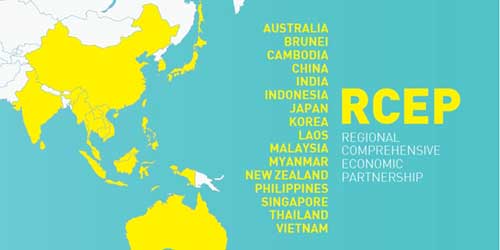
Countries from across Asia are convening in Melbourne this week to negotiate the Regional Comprehensive Economic Partnership (RCEP), a trade deal that would impact almost half of the world’s population, including Thailand, Indonesia, China, India, Japan, Korea, Australia and New Zealand that would undermine environmental protections in Asia.
Trade deals seem to be impenetrable and remote aspects of international legal systems that are disconnected from local and national realities. But in fact the opposite is true.
Trade and investment profoundly impacts local and national issues, and can undermine basic human and environmental rights and key principles of democracy.
Corporate profit
The RCEP focuses on trade and investment liberalization, intellectual property rights, services, competition policy – much like other trade agreements.
It would influence how governments regulate our economy. The talks go on behind closed doors and lack democratic oversight, so the resulting deal is likely to put corporate profit before public interest.
Leaked documents show that the proposed RCEP trade deal includes a mechanism called the Investor-State Disputes Settlement (ISDS).
ISDS is, in essence, a corporate court system in which companies can sue countries when they consider that government decisions or national court rulings impact on their profits.
In the rice paddy fields of Thailand, local farmers accused a gold mine of leaking toxic waste, causing serious health problems and ruining crops. The Thai government responded by suspending the mine, and later halting all gold mining in the country, while a new mineral law was developed.
But in 2017, instead of compensating the local communities for the harm caused, the Australian mine owners, Kingsgate, sued the Thai government for millions of dollars in compensation. They used the ISDS mechanism that was included in the Free Trade Agreement between Australia and Thailand.
The dispute between Kingsgate, environmentalists and local peoples, who say they had been negatively impacted by the mine, stretches back many years.
Operations were later suspended at the Kingsgate mine in 2015 for several months, amidst ongoing environmental protests and medical tests which found that hundreds of people living near the mine had high levels of toxic substances in their blood. The company itself acknowledged problems with dust, contaminated water, noise, and cyanide management in its own reports, and researcherscriticised its “lack of true community consultation”.
Democratic procedures
Environmental problems at Kingsgate’s mine occurred after violence had erupted at another controversial mine in the country, the Loei Gold Mine, when over 300 armed, masked men attacked and beat up villagers who were blocking access to the mine.
These problems in the gold sector led the military junta who were ruling the country to halt all gold mines nationwide in 2017 “due to their impact on locals and the environment”. While human rights groups welcomed the closure, the law used in the process has also been criticised, as they empower the Prime Minister to issue any order arbitrarily without following legal and other democratic procedures.
Kingsgate hit back with threats of a multimillion-dollar international arbitration lawsuit. This threat seemed to have paid off. In 2017 the Thai government agreed to lift the suspension on the mine’s operation, which in turn led to a steep rise in the company’s share price.
Yet Kingsgate has not re-opened the mine. Instead it filed the ISDS case under the Thailand-Australia Free Trade Agreement claiming expropriation and seeking damages of an undisclosed amount. According to the national media, the ISDS claim could be worth US$900 million, a figure the government has denied.
Toxic water
While the Australian government views ISDS cases like this one as defending the national interest abroad, it is, rather, a way for corporations to entrench their power at the expense of local communities.
Rather than engaging with national research institutes, the precautionary principle or the local community’s knowledge, the case will be decided by three investment arbitrators, applying narrow investment law in a secret back room process.
The arbitrators’ decision could impact the entire country through the precedent it sets for regulation in Thailand. And while the ISDS case is ongoing, the company has reportedly not rehabilitatedthe mine that was leaking toxic substances into water sources.
This is not an isolated example. New research has uncovered how afterColombia’s Constitutional Court banned mining activities in a sensitive ecosystem which provides drinking water for millions of Colombians, Canadian mining company Eco Oro sued the country for US$764 million in damages.
When Croatian courts cancelled illegal permits issued for a luxury golf resort in the city of Dubrovnik, Croatia was hit with a US$500 million compensation claim. Romania is defending itself from a shocking US$5.7 billion claim by Canadian mining company Gabriel Resources, after the country’s courts declared the company’s proposed toxic Roşia Montana gold mine illegal.
Accountability
The growing number of corporate lawsuits has raised a global storm of opposition to ISDS and the corporate trade agenda more broadly from across the political spectrum. Two countries party to the RCEP trade negotiations, Indonesia and India, have started to reform ISDS by cancelling Bilateral Investment Treaties.
Yet, as the RCEP is a regional trade deal, if ISDS corporate courts are finally pushed through in exchange for increased market access, it will likely be locked in for years to come.
Given the current global trade wars, governments seem fixated on rushing headlong into new agreements.
Rather than more of the same failed corporate trade models, we need a new trade policy that enables communities and states to hold investors and corporations accountable for their damaging environmental impacts and human rights violations.
The RECP negotiations in Melbourne will test governments’ capacity to look after the environment and their citizens.
The climate crisis ultimately reveals the failure of the supposed economic and technological “progress” of Western civilization. The majority is now aware that the neoliberal system, which claims to be committed to freedom and progress, has now failed. What the exploitation of workers, the worldwide hunger and the ever-increasing poverty have shown for decades finds its last proof in the climate crisis. Capitalism has not only uprooted and alienated mankind from (its own) nature, but has also attacked and dismembered nature to such an extent that all living beings are deprived of their livelihood. The climate crisis is not a natural development, nor is it, as some claim, the result of overpopulation.
The climate crisis is the result of unlimited production, unlimited market freedom and consumer orientation. It is a question of economic and energy policy, and therefore of the system in which we live. All statistics suggest that climate change is man-made and that greenhouse gas emissions are particularly due to the excessive use of fossil fuels in the mass production of goods under capitalism.
…
An ecological struggle must be explicitly anti-capitalist and must not make compromises with capital.
The next few years will present the movement with great challenges: It must not rely on parliamentary politics and must consistently fight against “green capitalism”.
The movements must not bow, and the only way to fight consistently is to develop a positive, socialist perspective for the future, a real alternative for which it is worth fighting. The demands and goals should therefore never be formulated only negatively, but should also contain concrete positive aspects for a livable, beautiful future for all. Those who cannot present an alternative will see no light at the end of the tunnel and will lose themselves in recurring aberrations.
Creating an alternative that brings together and involves all parts of society can overcome an incredible number of barriers. The example of self-governing structures in Rojava/Northern Syria shows the strength of political self-government.
“System change not climate change” is what many protests say. We should take this slogan at its word and organize a way of living together that is worth living for everyone in the world. The ecological struggle can only be internationalist, not only because regional changes do not bring much, but also because we have to be aware that the extreme greenhouse gas emissions of the so-called industrialised countries affect above all economically poorer regions, which lack the means to protect themselves from the effects. The supposedly progressive Western civilisation is responsible not only for its own crisis, but also for the degradation of nature everywhere. At the end of history, capitalism shot itself in the foot, and it is now up to people all over the world to shake the already broken system for good. from here: https://makerojavagreenagain.org/2019/06/23/against-green-capitalism/
In this episode, we speak with a member of the Black Rose Anarchist Federation, about the increasing threat of climate change, growing State repression against protest, new activist formations such as Extinction Rebellion, and legislative proposals such as the “Green New Deal.” Is there hope in the State being able to legislate the climate crisis away, or should humanity instead look towards building a material force through social movements as a means of ensuring survival in the coming decades?
Throughout this conversation we ask:
How should autonomous anti-capitalists and anarchists approach new formations such as Extinction Rebellion and the Climate Strike and push them in anti-capitalist, anti-authoritarian, and direct action orientation?
How can this new wave of energy feed into existing front line land defense and anti-pipeline struggles?
What should our stance be towards things like the Green New Deal?
How can we use the memory of struggles like Standing Rock to hammer home anti-statist, anti-colonial, and anti-capitalist ideas?









 Aotearoa/New Zealand Anti-Capitalist Green Front